
INTRODUCTION
For many years, a significant portion of the population in villages has relied on firewood, cow dung cakes, and coal, as well as other traditional fuels, for cooking. These fuels are inefficient as well as hazardous to health. The smoke emerging from burning these fuels was consequently causing respiratory diseases, eye problems, and even casualties. Casualties were found among women and children during cooking, as they were, in particular, spending more time in the houses. Moreover, collecting firewood was time-consuming, tiring, and often led to deforestation and environmental degradation.
Understanding these issues, the Government of India correspondingly decided to take steps towards improving the lives of its people by providing a mode to clean, safe, and affordable cooking fuel.
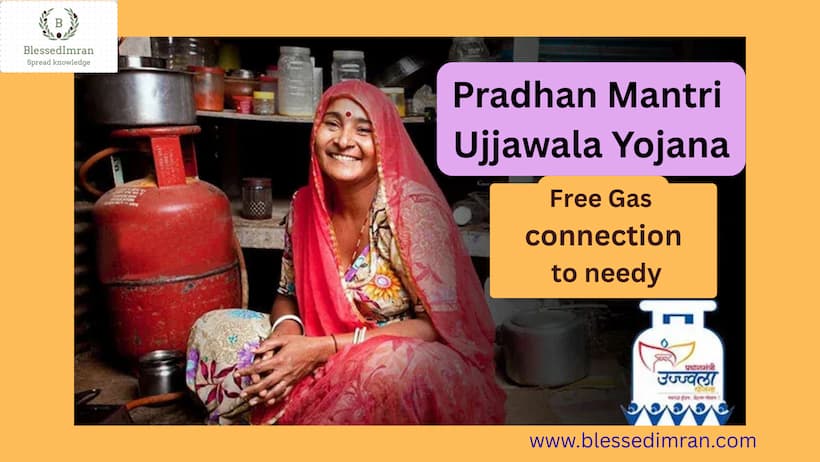
The Pradhan Mantri Ujjwala Yojana is, indeed, one of India’s most effective social upliftment schemes. It is formulated to provide especially clean cooking fuel to millions of households across India. It is a flagship scheme of the Ministry of Petroleum and Natural Gas and was launched in fact on 1st May 2016 by Prime Minister Shri Narendra Modi in Balia, Uttar Pradesh. Primarily, the scheme aims to provide free LPG connections to households falling under the Below Poverty Line(BPL). The Government aims to empower women, improve their health, and protect the environment, thereby minimising the use of conventional fuels.

OBJECTIVE OF UJJWALA YOJANA: –
The main objectives of the Ujjwala yojana are:
- To minimise health problems caused particularly by indoor pollution created by using conventional fuels.
- To reduce environmental degradation developed due to excessive use of firewood and other biomass fuels.
- To spread LPG coverage, especially in deprived and rural areas.
- To empower women and protect their health correspondingly by giving clean cooking fuels.
- To encourage gender equality by making women, in fact, the direct assignee of the scheme.
How does the scheme work: –
Eligibility Criteria:
Particularly, the scheme is targeted at women from BPL families. To be eligible:
1. A woman should belong to a BPL household, and moreover, no one in the family should already have an LPG connection.
- An applicant must be a citizen of India of age 18years or above, and furthermore, the gender should be only female.
3. The family income per month should not be more than the limit defined consequently by the state or union territory.
4. The applicant’s name should be there on the Socio-Economic Caste Census(SECC) 2011 data or alternatively on other approved lists.
Application process:
The application process for this scheme is very simple:
An eligible woman fills the two-page form providing all her basic details like Name, address, Aadhar card number, & further Bank account details, etc.
Applicant submits the application form along with Identity proof and, together with the BPL status document, to the nearest LPG distributor.
The verification authority verifies the application, and once approved, the woman gets a deposit-free LPG connection in her name.
In the current Ujjawala 2.0 phase, even the migrant families may apply for this scheme with an address self-declaration, which consequently makes the process more inclusive and less paperwork–intensive.
A woman may also apply for Ujjawala Yojana online by visiting https://pmuy.gov.in/ujjwala2.html.
The process is very easy. The desired person has to submit the soft copy of the required documents, like Aadhar card copy, Pan card copy, and BPL status documents, along with additionally basic details of the applicant.
What does the beneficiary receive once the application is approved?
Once the application is approved, a beneficiary receives the following:
- An LPG connection in the woman’s name, moreover, without any security deposit.
- User guide and safety instructions to educate and, moreover, ensure safe handling of LPG.
- In Ujjawala 2.0, the first gas cylinder refill and a hot plate are additionally given without any charge.
Implementation and success stories:-
When the Government launched the scheme, they set a target to provide 5crores LPG connections within 3years to BPL families. Considering the high demand and the scheme’s success, consequently, the target was increased to 8 crore connections by March 2020.
Because of support from LPG connection providers and the Government’s long-term vision, as a result, 8 crores LPG connection was given by September 2019, setting a major milestone. In the Union Budget 2021-22, the scheme target was further increased with an additional 1 Crore connections, especially for migrant families.
Consequently, the Government provided 9 crores connections by March 2021.
Ujjawala 2.0 was initiated in August 2021, and Ujjawala 2.0 notably achieved the target in Jan 2022, and the Government provided 10.6 crores LPG connections. The government is on a mission to provide free LPG connections and, furthermore, to do as much as possible.
Year-Wise Progress of Ujjwala Yojana
| Year | LPG Connections Provided Under PMUY |
| 2016-17 | 2.0 crore |
| 2017-18 | 1.5 crore |
| 2018-19 | 1.5 crore |
| 2019-20 | 1.2 crore |
| 2020-21 | 0.8 crore (COVID impact) |
| 2021-22 | 1.0 crore (Ujjwala 2.0 begins) |
| 2022-23 | 1.25 crore |
| 2023-24 | 1.5 crore |
| Total | More than 10 crore connections |
Benefits of Ujjawala Yojana:-
1. Environmental Benefits: Because of the maximum use of LPG by households in India, biomass and firewood usage have been reduced, which finally helps to prevent deforestation and save the environment. Moreover, lower indoor air pollution encourages a cleaner and healthier atmosphere at home.
2. Health Benefits: Because of the lower risk of inhaling smoke at home, the cases of respiratory diseases, eye problems, and other health issues among women and children have come down. The scheme has drastically decreased the number of deaths caused by unclean cooking fuels.
3. Women’s empowerment: Women don’t need to spend time searching for wood, which gives them extra time for education, other work, and taking care of their family. Also, Women get social and financial empowerment with the LPG connection in their name.
4. Economic and Social Impact: Increased LPG connection gives confidence to the Government for achieving a modern and energy-efficient India. The scheme generated jobs in stove manufacturing, LPG distribution, and other related areas and thus helps in economic upliftment.
Though PMUY has changed the lifestyles of many in rural areas, it has faced a few challenges:
1. Awareness gap: In some remote villages, people are still unaware of the scheme. The implementation eventually slows down because of the proper information.
2. Refill affordability: Some poor families find it difficult to bear the cost of refilling the LPG cylinder, and then they come back to the traditional method of cooking.
3. Safety issues: Because of a Lack of knowledge and fire accidents, some people are afraid of using LPG. For safe handling, the Government should provide proper training to safely handle the LPG cylinders at home.
Government’s action to handle the above challenges:
-
- The government has taken steps to solve these problems:
- Awareness campaign on the health benefits of LPG.
- Subsidies on LPG refills for poor families to make it cheaper.
- Safety demonstration and training during installations.
- Under Ujjawala 2.0, the Government is putting effort into including seasonal laborers and migrant workers.
WAY FORWARDS:-
1. More awareness campaign: The Government should use radio, TV, and village meetings to educate farmers and bring awareness about the scheme.
2. Simple registration process: A one-page form with required fields and help from CSCs can ease the process.
3. Faster Claim Settlement: Claim settlement can be made easy and streamlined. GPS, Drones, and mobile apps are helpful tools for faster claim settlement.
4. Farmer training: The Government should train the farmers about the benefits and process of registration for this scheme.
5. Strict Monitoring of Insurance Companies: The Government should monitor the working of insurance companies and ensure timely and fair payment.
CONCLUSION:-
Pradhan Mantri Ujjawala Yojana is a remarkable scheme that has improved the lives of over 10crore families across India. It has improved the lifestyles of people, empowered women, brought dignity to the kitchen, and protected the health of the poor. Pradhan Mantri Ujjawala Yojna is not just a Gas connection, but it’s a movement to change the lives of the Indian population. It is ultimately dreaming of a healthier, cleaner, and self-reliant India.
Though there are some challenges on its way to success, the Government is putting all efforts to share continued awareness, education, make gas refill affordable, and follow up to enhance more and more LPG connections to needy families.
The Government can achieve a smoke-free rural India when every family has access to clean and affordable fuel for a lifetime.
This scheme can be a great success if educated citizens of India come forward and spread the knowledge about the scheme and encourage the eligible families to apply for this to get an LPG connection. We, the educated and responsible citizens, should ensure that no mother or sister in our country has to cook in smoke anymore.