
INTRODUCTION
No pollution, no noise- Just a smooth and comfortable ride to your destination. This is not a dream, but it is going to become a real lifestyle under PM eBus Sewa. This ambitious initiative, launched by the Government of India, is more than a transportation project. The PM eBus Sewa is a flagship central Government scheme designed for expanding city bus operation by arranging 10000 electric buses(e-Buses) across various Indian cities. The scheme aims at cities where there is no proper public transport facility is available. Especially the scheme targets those cities whose population lies between 3 lakhs and 40 lakhs. A massive budget of 57613 crores has been approved for making this scheme a big
Key Highlights at a glance:-
1. Target: 10000 electric buses need to be deployed in various cities
2. With 20000 crore central assistance, the total budget of the scheme is 57613 crore.
3.The scheme has spread in more than 170 cities across India.
4.Support for bus operation is provided for 10 years under this scheme.
5.Public-Private Partnership (PPP) on a Gross Cost Contract is model followed for this scheme.
The two main segments of the scheme:-
The scheme is grouped into two different segments to ensure overall transformation:-
Segment A: Augmenting City Bus Services
This segment focuses on the physical availability of buses.It includes:
- Arranging 10000 e-Buses in 169 cities.
- Developing Behind the Meter (BTM) Power infrastructure to support heavy-duty charging. It is similar to substations.
- Creating and upgrading bus depots.
Segment B: Green Urban Mobility Initiatives(GUMI)
This segment covers 181 cities and aims to make public transport more efficient and smarter through:
Multi-model Interchange: Connecting buses with metros and trains without any disruptions.
Bus Priority Infrastructure: Separate lanes to speed up the journey.
National Common Mobility Card(NCMC): A “One nation, one card” system for easy digital payment.
Intelligent Transit Management System(ITMS): Real-time tracking and scheduling for passengers.
How the funding works:-
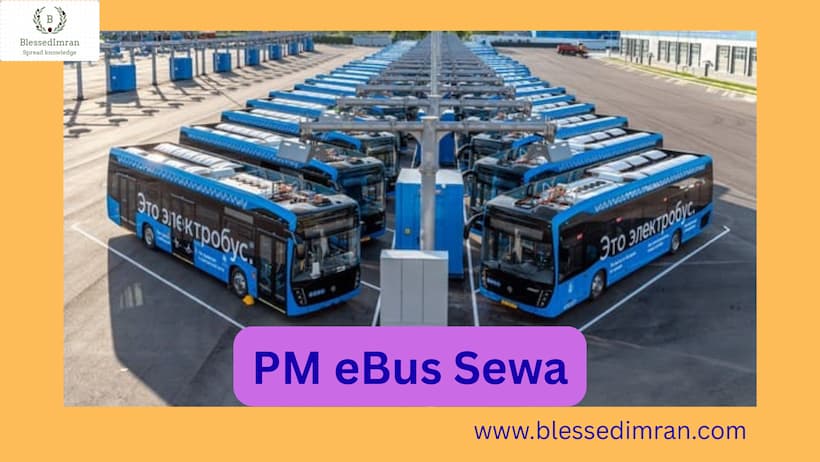
The high initial cost of electric vehicles (EVs) is one of the main obstacles to their adoption by state governments. To solve this, the PM eBus Sewa offers substantial financial support:
Central assistance is provided under this scheme as follows: 100% central assistance for Power Infrastructure(BTM), 60% CA for Civil depot(states), 90%-100% for Civil depot (Hilly/NE/UTs), and, depending upon bus size, ₹20 – ₹24 per KM operation support is provided by Central assistance. Operation support is provided until March 2037, ie For till next year.
Success stories: where are we in 2026:-
The scheme has achieved appreciable milestone till 2026.The government has already released 9600 buses for 110 cities.
Gujarat is on the top of receiving the benefits: Inauguration of the first 50 e-Buses is witnessed at Bhavnagar at Gujarat.
Infrastructure: More than 300MVA of power and over 300acres of land have been sanctioned to support these buses.
Payment security: With a budget of more than ₹3,400 crore, the new Payment Security Mechanism (PSM) guarantees that private operators are paid on schedule, making the business model viable and appealing to investors.
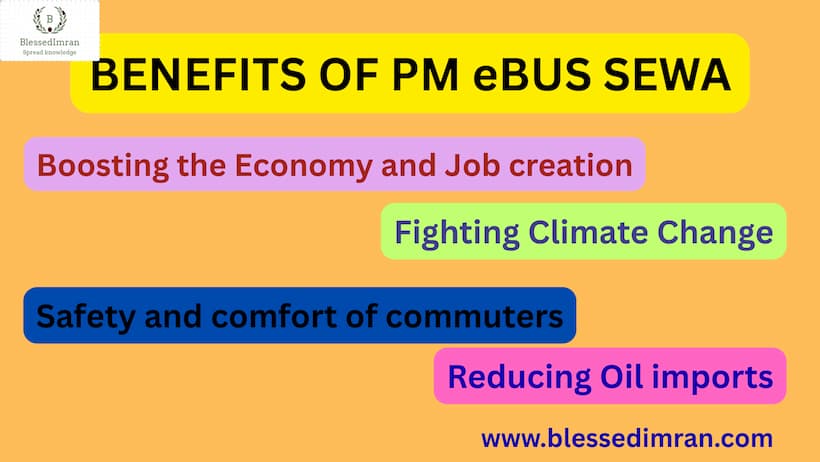
Benefits of PM eBus Sewa:-
PM eBus Sewa is a game-changer for India. The following are the remarkable benefits of this service.
1. Boosting the economy and Job creation:
The scheme is expected to create 50,000 to 60,000 direct jobs. Not only driving jobs but also skilled technicians, software developers for ITMS, charging station operators, and battery maintenance experts are a few jobs position will be opened for Indian youths.
2. Fighting Climate Change
No doubt, transportation is the main contributor to carbon emissions. India is remarkably reducing its carbon footprint by replacing traditional diesel buses with electric ones. These eBuses release zero tailpipe emissions, helping to keep the environment clean and keep the air breathable.
3. Safety and comfort for commuters
These eBuses are not the normal buses most people use. Most of the eBuses are:
Safe: Equipped with emergency buttons and CCTV cameras. Control of the main doors is in the driver’s hand, so that he operates them as per his understanding.
Air-Conditioned: All eBuses are air-conditioned, which is a necessity in India’s summer.
Accessible: Designed for “Divyangjan”(person with disabilities). It is designed in such a manner that a person with disabilities may board the bus and sit comfortably at his seat.
4. Reducing oil imports:
India spends billions of dollars every year on importing crude oil. Through this scheme, the dependency on petrol/diesel is drastically reduced.eBus Sewa uses domestic electricity, which consequently helps in making India Atmanirbhar (Self-reliant) in the energy sector.
Challenges ahead:-
Though the e-Bus service is proceeding ahead with so many success stories, challenges are present:
Maintenance: As e-Bus is a new technology for India, consequently, finding a workforce for maintaining and handling high-voltage batteries is difficult.
Grid Capacity: Charging more than 10000 buses requires a huge amount of electricity. Upgrading the existing local power plants is a challenging task for local Governments.
Route optimisation: For the scheme to be successful, cities must ensure to pass through the routes where people board the buses.
CONCLUSION:
PM eBus Sewa is not only a transport scheme, but it promises to overall uplift the lifestyle of the common citizen. It also promises to provide a better and cleaner environment for the next generation. By expanding the mission to tier-2 and tier-3 cities, the government is giving a guarantee that Modern India is not just limited to Kolkata or Delhi.
Though there are some challenges on the way to success, various agencies
The eBuses are playing a major role in keeping the environment clean.
The e-Buses in India are becoming the symbol of a smarter, faster and cleaner India.