

INTRODUCTION
The Indian population depends terribly upon groundwater for agriculture, Industry and drinking purposes. The groundwater level is declining day by day, and hence, sustainable groundwater management is urgently needed. The declining groundwater in India posed so many challenges for citizens of India, and hence, to address the issue, the Central Government of India launched the Atal Bhujal Yojana(ABY), also called as Atal Jal, on 5th Dec 2019. The Government of India named the scheme in honor to former Prime Minister Shri Atal Bihari Vajpayee. It is a five-year scheme initiated by a fund of ₹6,000 crores. The scheme’s main focus is on areas suffering from severe groundwater depletion and recharge of groundwater resources, and minimising the exploitation of groundwater resources. The goal of Atal Bhujal Yojana is to correspondingly facilitate community-led sustainable groundwater management, which can be taken to scale.
Main features of Atal Bhujal Yojana:-
1. The Ministry of Water Resources, River Development and Ganga Rejuvenation, which is also known as the Jal Shakti Ministry, implemented and reviewed the scheme.
2. The Government of India take care of 50% cost of implementation of the scheme, while the World Bank bear the remaining 50% in the form of a loan.
3. To achieve the Groundwater management target and to encourage community participation Government has planned to give 50% of the money to the Gram Panchayat and states as an incentive.
4. The government water-deprived has implemented the scheme in 8353 water deprived Gram Panchayats of Gujarat, Madhya Pradesh, Haryana, Rajasthan, Karnataka, Uttar Pradesh and Maharashtra. The scheme has two modules:
Institutional Strengthening & Capacity Building module for which investment made is INR 1400crores.
Incentive module for incentivising the states, for which investment made is INR 4600crores.
OBJECTIVE OF ATAL BHUJAL YOJANA:-
- The scheme focuses on groundwater management in priority areas in the nation, specifically through community engagement and participation.
- Encourage techniques to save water, particularly drip irrigation and rainwater harvesting.
- Support the Jal Jeevan Mission’s objective of providing household tap water.
- Through community involvement, it correspondingly promotes sustainable water management.
- Two major types of groundwater systems found in India are specifically alluvial and hard rock aquifers. These areas are accordingly covered under this scheme.
- Priority areas covered include specifically Gujarat, Madhya Pradesh, Haryana, Rajasthan, Karnataka, Uttar Pradesh and Maharashtra. These states cover approximately 25% of the total number of critical, semi-critical, and overexploited groundwater areas in India.
- It also focuses on bringing about behavioural change at the community level, especially through capacity building and training awareness for encouraging sustainable groundwater management in identified states.
How does the scheme work: –
The scheme has two main modules:
1.Institutional Strengthening & Capacity Building (₹1,400 crore):
This module is primarily about making a strong system for groundwater management.
- Training residents and officials on water management.
- Disclosing groundwater data available to the public so everyone can understand the severity of the situation.
- Collecting accurate data using instruments like rain gauges, water testing kits and a piezometer (for rain water level).
The budget allocated for this activity is INR 1400 crores.
2. Incentive component (₹4,600 crore)
This module distributes prizes to motivate the gram panchayat and states that when they achieve some targets, such as
- Showing improvement in groundwater level
- Increasing use of new irrigation techniques like drip and sprinkler systems, and irrigation by rainwater.
- Developing water security plans (WSPs) for each Gram Panchayat.
- Sharing data with all and being transparent with the community.
- Encouraging the diversion of crops to minimise water use.
The money is not given in advance but is linked to performance. This ensures that it is result-oriented and not plan-oriented.
Community Led Water Security Plans:-
One essential attribute of this scheme is that community members themselves create plans for conserving groundwater.
It works like this:
- Villagers, along with NGOs, local bodies and Self-help groups(SHGs) come forward together.
- They study the level of water and study for what purpose water is mostly used in that area.
- Based on the above studies, they create a water security plan, which includes the following steps:
- Building recharge pits and check dams.
- Using drip/sprinkle irrigation
- Shifting to minimum water-intensive crops.
- Protecting water storage
Community displays the water security plan publicly in villages- on walls, notice boards, and sometimes even on mobile apps so that everyone knows the targets and achievements.
DLIs (Disbursement Linked Indicators) and Targets:-
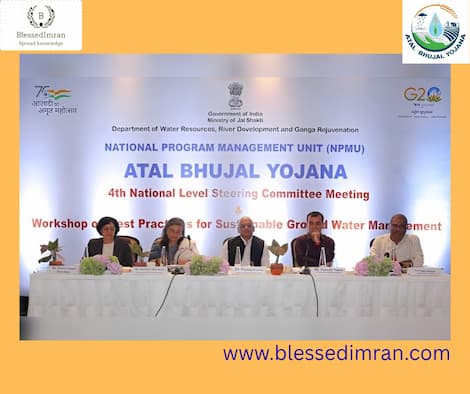
The scheme has 6 major DLIs (Disbursement Linked Indicators):
- Preparation of Water Security Plan: Gram Panchayat/Villages create their own scientific as well as community-based water plans to meet the requirements of the community.
- Focusing more on groundwater monitoring: Increasing the monitoring network, data collection and public disclosure of groundwater data.
- Requirement-based management: Boosting community participation to minimise excessive water pumping and, correspondingly, encouraging water saving technologies.
- Capacity building and Institutional strengthening: Awareness among people, training of officials and powering groundwater institutions.
- Public disclosure and Behavioural change: Encouraging people in decision-making, data transparency and awareness campaigns.
- Agricultural water management: Efficient irrigation, encouraging crop diversification and less water-intensive farming practices.
In a nutshell, DLI refers to milestone targets. The World Bank releases funds to India only after achieving these targets. These targets are like preparing a water plan, reducing groundwater use, or
IMPACT SO FAR: –
The scheme is under progress (2019-2025), and consequently, the results are visible.
- Funds utilised: The Government has utilised about 2900 crores of funds out of 3500crores allocated for the scheme for different activities.
- Training programs: The Government have arranged over 1 lakh training programs at the gram panchayat level to educate villagers and farmers about this scheme.
- Efficient irrigation: As a result of Atal Bhujal Yojana, more than 7Lakh hectares of land have adopted mulching, sprinklers, drip or crop diversification.
- Groundwater Recovery: More than 900 gram panchayats have shown improvement in water levels.
Awareness campaign: Moreover, to spread water-saving messages, villages have organised rallies, meetings, folk art events, wall paintings and street plays.
SUCCESS Stories from notable states:-
1. Rajasthan:
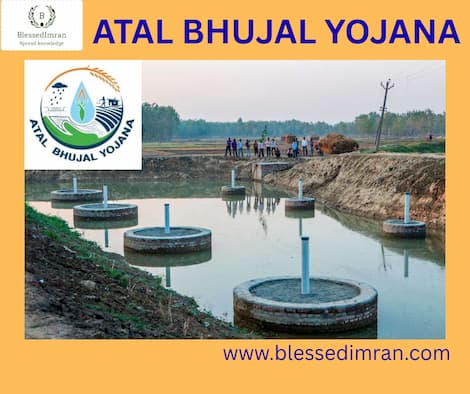
- The scheme was launched in 38 blocks, which correspondingly covered 1132 Gram panchayats, some blocks in Kota, Chittorgarh, and Ajmer. These Gram Panchayats have exhibited remarkable groundwater recovery.
- Scheme consequently expects Rajasthan to stabilise or reverse groundwater decline by 2025 in various project areas.
2.Haryana:
- Haryana is among top performing states and two districts are under National top-5. VWSC (Village Water and Sanitation Committee) have been formed in all 1656 Gram Panchayats across 36 blocks.
- Johad (natural ponds) revival, groundwater data collection training nearly 700000 people are markedly some success attributes.
3.Maharashtra:
- The state has promoted micro-irrigation and consequently covered
135000-hectare area against the target of 75000 hectares by March 2025.
- Remarkable groundwater increment observed in 37talukas and 71 watershed areas, with lots of improvement in other areas also.
- State has markedly organized Bhujal Samrudh Gram competitions for creating awareness among people. Hundreds of Panchayats participated and winners awarded up to 1crores.
4.Uttar Pradesh
- Over exploited blocks reduced from 82 to 50, Critical blocks from 50 to 42.Moreover, In 26 blocks across 10 districts, groundwater levels improved.
- As a whole 800panchayats targeted. Furthermore, UP plans to spread the scheme to remaining 65districts.
Extended Scheme period:-
The actual scheme plan was 2020-2025, but due to COVID-19, it was delayed, leading to a 2-year extension. It ultimately benefited 9,000 panchayats across different states.
Digital Tools and Innovations:-
Atal Jal app is a new mobile app which markedly, allows villagers to access groundwater reports and data. This plan includes basically universal rainwater banks, domestic water recycling tech and telemetric monitoring.
Why this scheme is different:
Irrespective of other Government scheme that focuses on infrastructure, Atal Bhujal Yojana is different because of the following reasons:
- It operates from the bottom up – Villagers and local communities decide the action, not only officials concerned.
- There is accountability, as it links money to measurable results.
- It synchronises technologies, transparency and tradition- Modern tool with traditional knowledge.
- This scheme promotes to use of less water, rather than only creating more supply, and thereby encourages demand side management.
Looking ahead
The Government plan to operate the scheme till 2025, but it has given a new perspective to people, which will last much longer:
- States develop the scheme for more water-stressed areas.
- Villages and local communities celebrate a festival after achieving any target, and correspondingly, appreciation, and this makes people aware of the scheme.
- Communities keep following and updating their respective water security plan.
- As part of the syllabus, schools and colleges teach water management.
Atal Bhujal Yojana may become a model for the world to save groundwater, and it has that kind of approach. It shows the world that when local bodies and people are involved in any improvement work, huge challenges may be overcome.
CHALLENGES AND WAY FORWARD: –
Challenges:-
- Crop Pattern issue: In many areas farming of those crops which needs more water still there.
- Ground water overdependence: For irrigation purpose many farmers still practices bore well irrigation which negatively affect groundwater.
- Climate change: Increasing temperature and untimely and irregular rainfall affect water reserves.
- Monitoring data gaps: Planning gets difficult in view of availability of accurate local data on groundwater use.
- Behavioural changes: Changing people mind set to practice water saving is difficult.
- Limited community engagement: Participation in water saving is low in some villages.
WAY FORWARDS:-
1. Promote crop diversification: Pulses, oilseeds and millets are better crop option than water-intensive crops, and they may promote crop diversification as a whole.
2.Build up rain water harvesting: Construct more recharge pits, ponds and check dams.
3.Encourage Micro-harvesting: use of sprinkler systems and drips for micro harvesting.
4.Use advanced technology: Mobile apps, sensors, GIS mapping and display units to be made available for groundwater monitoring.
5.Spread awareness: Awareness training and campaigns at grassroot level to be imparted.
6.Reward the best practices: More incentives and other monetary benefits to be given to communities who utilize water smartly.
CONCLUSION:-
Atal Bhujal Yojana is an effective step toward addressing India’s growing groundwater crisis. The scheme tells us that saving water is not only the responsibility of the government, but also the responsibility of every citizen. The scheme encourages people to take charge of their water resources by involving panchayats, farmers and local communities.
Many villages have started witnessing positive results by implementing rainwater harvesting, micro harvesting, Crop diversification and the use of advanced technology.
Though the journey is long, the success depends upon care for nature, constant awareness and cooperation. Atal Bhujal Yojana is more than a scheme- It is a movement to protect our most valuable resource, ie, water. If every person uses water wisely, we can secure a sustainable and safe future for our children. Let us join hands to save water for a better and greener future.