
INTRODUCTION
The River Ganga is not just a river, but Indians view it as a symbol of faith, sacrifice and love in India. She is an emotion; she is a faith. From the snowy high Himalayan series to the wide plains of North India, the river Ganga has been nurturing the land, cities, culture and civilisation as a whole for thousands of years.
But with time, the devotees and population living near this holy river started gradually polluting it. Wastewater correspondingly flowed into it. Pollution increased day by day. People dump plastic and industrial waste into this river, which consequently pollutes the river more. The river, which gave birth to many civilisations, presently began to struggle for breath.
To restore the strength and purity of the holy river, the Government of India launched the National Mission for Clean Ganga(NMCG), and furthermore the Government registered this scheme in 2011 under the Societies Registration Act. It works under the Ministry of Jal Shakti. Its Main objective is to clean, save and also to rejuvenate the river Ganga and its tributaries. Correspondingly, the Government of India in 2014 launched a larger and widespread program called the Namami Gange Programme. The main implementing body for Namani Gange is NMCG.
It is declared a national mission, which altogether shows how serious the Government was to restore the holy Ganga.
MAIN OBJECTIVE OF THE MISSION: –
1. Reducing Pollution: Because of untreated sewage from cities and towns, the river water was getting polluted raising a big concern. The mission correspondingly started to construct Sewage Treatment Plants (STPs). These plants process the polluted water and then release it into the river.
Moreover, industrial waste was a major contributor to river pollution. So under this mission, the Government strictly monitored these industries. As per guidelines by Government agencies, factories that discharge waste into the river have to treat the waste properly before discharging to river. If they fail to do so, the Government fine them for the same.
2. Rejuvenating the river: The cleaning of the river doesn’t serve the purpose. The river must attain its natural tendency after cleaning. The mission also focuses on
- Planting trees
- Safeguarding and fencing river banks
- Maintaining environmental flow
- Conserving biodiversity
The mission not only cleans the water but heals the ecosystem.
KEY ACTIVITIES UNDER THE MISSION: –
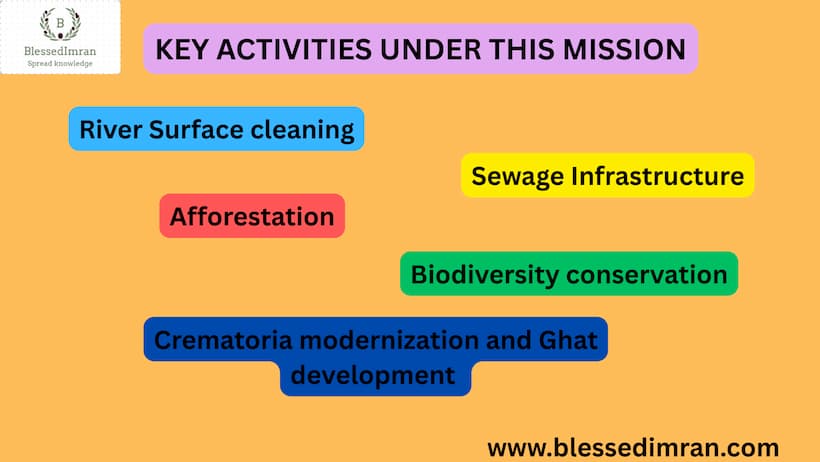
The following are the key activities under NMCG:-
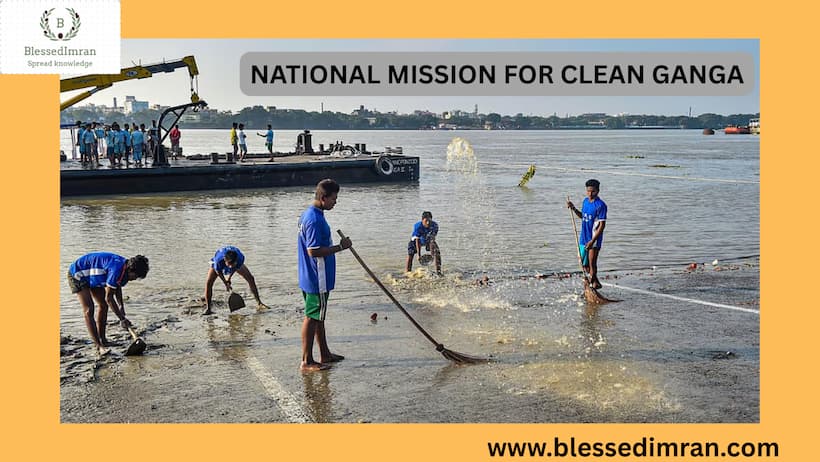
1. River Surface cleaning: People in boats collect floating wastes like flowers, plastics, and garbage as part of the River surface cleaning drive. Volunteers from this Mission remove these wastes daily.
2. Sewage Infrastructure: In many towns, the sewage agency discharges the wastewater directly to the river, and there are no proper sewage systems.
Under this mission, the Government have constructed many sewage treatment plants. The Government use advanced technology to treat the water effectively. This is a major step towards pollution control.
3. Afforestation: Tree planting along the riverside started as part of this mission. Afforestation reduces soil erosion and improves the river’s health.
4. Biodiversity Conservation: Rivers are home to many aquatic creatures like turtles, fish, Gangetic dolphins, etc. The Government have started many special programs to protect these species.
5. Crematoria modernisation, & Ghat development: Ghats have some religious importance, and it needs proper maintenance. Now, under this mission, the Government is renovating and cleaning the Ghats. The Government is promoting Electric crematoriums to reduce partially burnt bodies entering the river.
Community Participation-The Real strength:-
The success of any scheme or mission launched by the Government depends on the local community. No mission can succeed without people’s participation. Understanding this fact, awareness programs are conducted in schools, villages and local panchayats. Local communities are motivated to keep the surroundings clean and tidy. Volunteers, NGOs and youth groups are actively participating in the mission to make it a big success.
What can we do as citizens?
Without individual sincere interest and involvement, any Government program will not be fruitful.
Here are some simple steps we, as responsible citizen may take:
- Reduce use of plastics
- Support Local cleanliness drive
- Don’t dispose of waste into the rivers
- Spread awareness among residents.
- Educate children about environmental responsibility
Technology and Innovation
Public-Private Partnership (PPP) models are used for sewage projects. This ensures better accountability and maintenance.
Data is collected, analyzed and consequently action is taken to control the pollution, if any.
This mission is not operational on conventional methods, but advanced technologies are introduced, and real-time water monitoring systems are installed at various places. This checks the water pollution level on real time basis as a whole.
Success stories:-
There are apparent improvements in many locations of the river. The quality of river water has improved in many places. People are becoming more aware and attentive. Today, talks about the river cleanliness are more common than earlier.
More sewage treatment capacity has been created than ever before. Villages along the Ganga have been declared open-defecation-free under the Swachh Bharat Mission, which ultimately helps keep the river clean and pollution-free.
Social and Economic Impact:-
Clean rivers are not only about the environment and religion. They also help in improving the economy.
- Farmers get cleaner water for irrigation.
- Clean river cities boost tourism
- Fishermen get good and healthy fish because of better aquatic life.
- Health expenses of nearby residents reduce when water quality improves
Challenges and the Road Ahead:-
Let’s accept one thing that cleaning a river as big as the Ganga is itself a herculean task. Some major challenges include:
- Population Growth
- Rapid urbanization
- Lack of awareness in some areas
- Industrial expansion
- Illegal dumping of waste
Though the progress of this mission is happening steadily. Sometimes it is delayed because of land issues or technical problems.
The journey of cleaning the Ganga is difficult, but we are moving in the right direction. The mission is not only about removing waste, but it is about restoring culture, pride and ecological balance.
The action plan is as follows:
- Upgrading development of riverfronts
- Boosting industrial monitoring
- Enlarging sewage infrastructure
- Encouraging sustainable agriculture
With continued and sincere effort by the Government and community, the dream of a clean and healthy Ganga can become a reality.
CONCLUSION:
This mission is a transformational initiative by the Government and one of the most important environmental initiatives. It represents hope as well as responsibility. The mission is our respect for the environment, and especially the rivers like the Ganga.
The Ganga has provided life to residents living on river bank for ages. Now it’s our turn to give life back to the dying Ganga.
The national Mission for Clean Ganga is not only a mission but a movement. It is a movement that reminds us of a truth that:
If we protect nature, nature protects us.
Mission will be a success not only by writing or reading about this mission, but by actively participating in the cleaning of the river Ganga. Because the residents of India will feel strong and active when the Ganga flows clean and strong.